
The semiconductor manufacturing process demands extreme levels of precision and cleanliness.
In such environments, process equipment and their component parts are repeatedly exposed to high temperatures, plasma, and various chemical reactions. As a result, diverse forms of contaminants gradually accumulate on their surfaces.
Over time, these contaminants can degrade equipment performance, cause process instability, and generate particles—ultimately leading to reduced product yield and compromised quality.
To mitigate these issues, the semiconductor industry relies heavily on cleaning technologies for equipment components, which are essential for periodically removing accumulated contamination and restoring functional integrity.
Semiconductor component cleaning is generally categorized into chemical cleaning and physical cleaning. Depending on the process conditions and part geometries, a combination of cleaning methods is often employed.
Chemical cleaning involves the use of chemical agents such as acids, alkalis, surfactants, and oxidizers to induce chemical reactions with the contaminants and remove them from the surface. This approach enables precise removal of microscopic impurities while minimizing surface damage.
Physical cleaning, on the other hand, removes contaminants through physical means such as high pressure, heat, or ultrasonic energy. It is particularly effective for removing coarse particles or debris and is often used in conjunction with chemical cleaning depending on the part’s material and shape.
This article focuses on one of the key chemical cleaning techniques: surfactant-based cleaning for semiconductor components.
■ Surfactant-Based Cleaning Technology
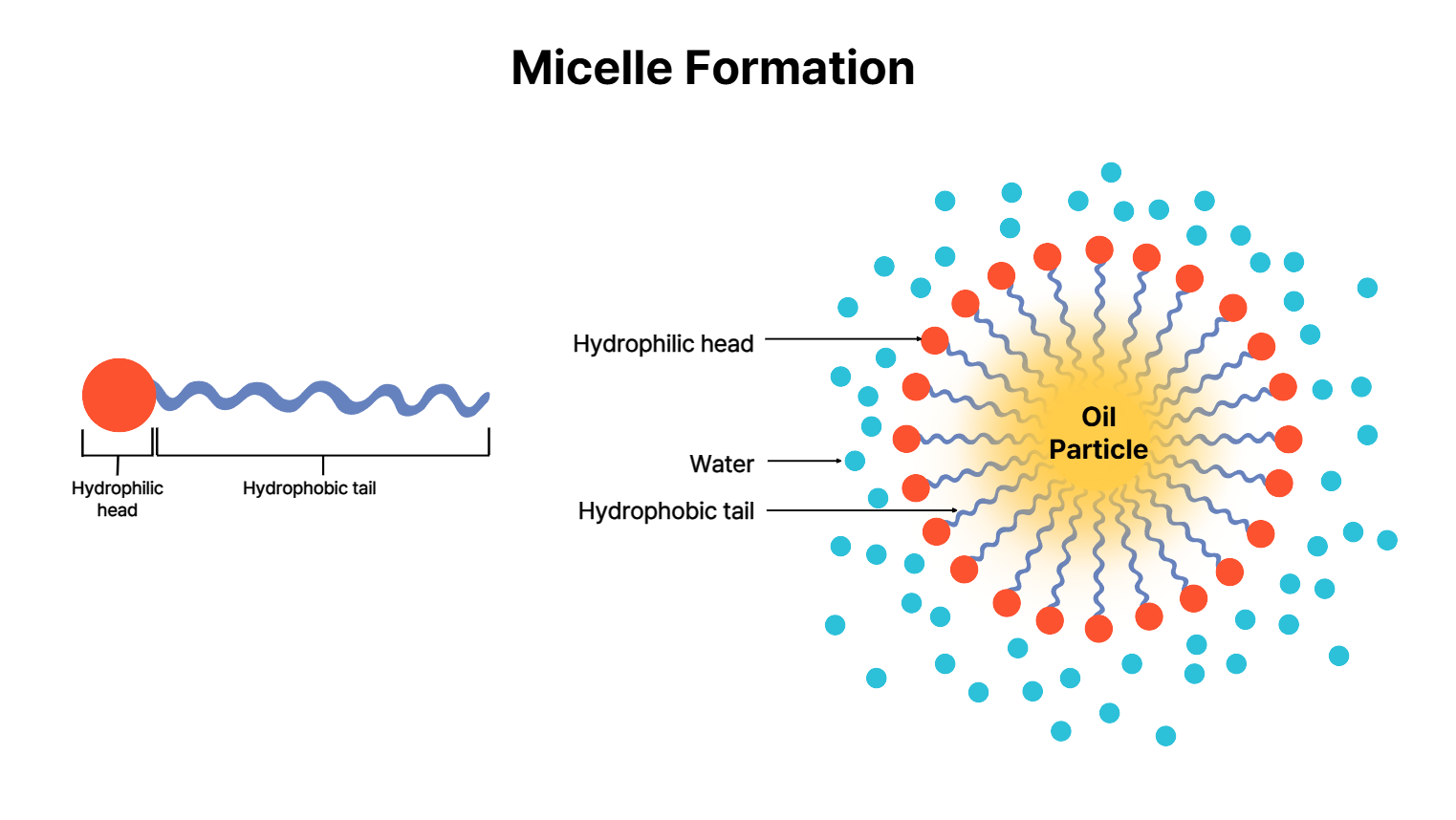
Surfactants are molecules that possess both hydrophilic (water-attracting) heads and hydrophobic (water-repelling) tails within the same molecular structure.
This amphiphilic nature allows them to interact with a wide range of contaminants—including oils, particles, and organic residues—and effectively mobilize them into aqueous solutions.
When surfactants are dissolved in water and reach a certain threshold concentration, known as the critical micelle concentration (CMC), the molecules self-assemble into micelles. In these micelles, the hydrophobic tails orient inward, forming the core, while the hydrophilic heads face outward toward the surrounding water.
These micelle structures are capable of encapsulating hydrophobic substances—such as oils and organic contaminants—within their cores, thereby enabling their stable dispersion in water.
This process is referred to as solubilization, and it represents the core mechanism behind the cleaning action of surfactant-based chemical cleaning systems.
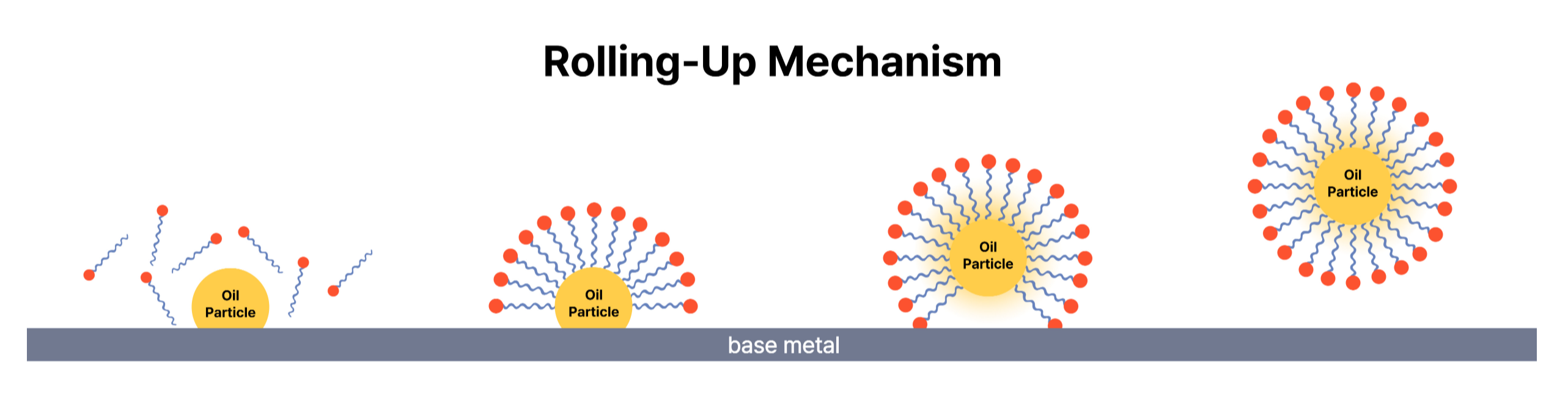
Based on the aforementioned principles, surfactants penetrate the interface between the contaminant and the substrate, weakening the adhesion forces.
This facilitates the “rolling-up” mechanism, in which contaminants are lifted and rolled away from the surface, enhancing the overall cleaning efficiency.
Surfactant-based cleaning is one of the most widely adopted techniques for cleaning semiconductor equipment components. In semiconductor processes, various types of contamination—including organic residues, metal ions, and fine particles—are commonly present in complex mixtures.
Surfactants are particularly effective at removing such multi-phase and mixed contaminants, making them indispensable in this context.
Coming Up Next
In the next article, we will introduce cleaning technologies based on redox (reduction-oxidation) reactions.
This approach leverages controlled surface corrosion to remove contaminants from component surfaces and is particularly effective in high-precision semiconductor processes.
We appreciate your continued interest and look forward to sharing more in the next installment.
<About KoMiCo>
KoMiCo, established in 1996, was the first company in Korea to commercialize cleaning and coating services for semiconductor equipment components. With global operations spanning the United States, China, Taiwan, and Singapore, KoMiCo has earned quality certifications from some of the world’s leading semiconductor manufacturers, solidifying its position as a Global No.1 in the industry.
Building on its advanced cleaning and coating technologies, KoMiCo continues to enhance its core business while expanding into the development and supply of key OEM components for semiconductor equipment. Moving forward, the company remains committed to improving customers’ productivity and yield, and aims to become a global leader in the semiconductor component cleaning, coating, and manufacturing industry.
'Business' 카테고리의 다른 글
| [KoMiCo Lab] Cleaning Technology Using Redox Reactions (0) | 2025.07.29 |
|---|---|
| [KoMiCo Lab] 산화 환원 반응을 이용한 세정 기술 (1) | 2025.07.29 |
| [KoMiCo Lab] 반도체 부품 세정의 핵심, 계면활성제를 이용한 세정 기술 (1) | 2025.07.23 |
| [KoMiCo Lab] Surface Solution for High-Density Process Environments: ALD Coating (1) | 2025.07.21 |
| [KoMiCo Lab] 고집적 공정 환경을 위한 표면 솔루션 : ALD Coating (0) | 2025.07.18 |